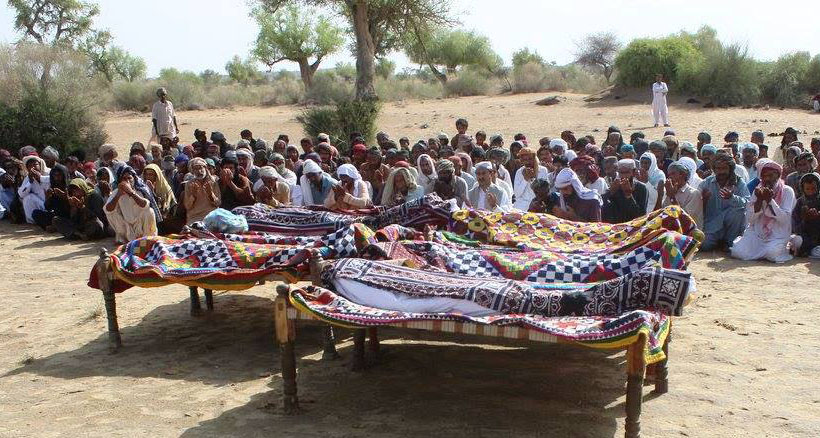
UMERKOT: Khameso, an old man of Thar, cried over the bodies of his two sons, killed in a terrorist attack in Turbat, Balochistan last month. “My sons, you were too young to leave this world. It was my time to die. I don’t know who will look after me and my two daughters now.”
The boys were among five dead bodies of the victims of Turbat massacre that arrived in the arid desert to the Thar people. Khameso’s mournful cries echoed the larger question for his community. The families of the dead, broken already by the persistent drought and the apathy of the government, had only one question in their minds: Who will take care of them from now on?
Twenty laborers lost their lives when the insurgents of Baloch Liberation Army killed them while sleeping and claimed responsibility. They were working on Sohrab Dam in the Gobdan area of district Turbat, when the fateful event occurred. These people had left their homes to escape death from hunger, but least did they know that terrorism, another menace inflicting this country, had been waiting to devour them. Many people have left Thar over the years, and more so in the last three years to avoid the deadly drought.
Bharumal Amrani, a writer and a social activist, while talking to News Lens Pakistan said, “Thar, a rain-fed agriculture region, has become a living hell.”
Thar comprises three districts, Tharparkar, Umerkot and Sanghar, and none has any industry to support the local population. “Two million Tharis and eight million livestock have been facing drought for three consecutive years,” Amrani said.
Majeed, another victim of Turbat attack, was the only son of his parents. He had gone to Turbat to earn livelihood for his family and to make enough money to marry off his sisters. Majeed had six sisters and only three were married when he was killed. Now Majeed’s father Sonharo hopes that the government might do something for them. The widow of another victim Laloo is not sure how she would spend the rest of her life with a young daughter to bring up. So is the fear gripping Dhani Bux who had also lost his son in this massacre. Dhani is paralysed while his other son is mentally challenged. Their life has already ended.
Though the people of Thar do not know what future holds for them, they are no more willing to let their sons venture out of Thar to make a living. A local journalist Sanjay Sadhwani told News Lens that after the incident Tharis prefer dying of hunger than from a bullet away from their homes.
Makwano the resident of Chonnhar village in Tharparkar told News Lens that these were very pressing times for the people of Thar. In the absence of economic opportunities and persistent drought, young men have been forced to migrate to other cities to earn their living for themselves and their families. Nearly every family has at least one male member working outside Thar. He deplored that even small boys are sent to big cities to earn for their families. Not that people here were unaware about the situation in Balochistan, he added, but they had no choice except to take a chance.
Many Tharis are still working in Balochistan. They cannot return because their employers have withheld five months’ salaries to pressurize them to stay back. He said that Sindhis had always been safe in the hands of the Baloch rebels, but this incident has changed the scenario. According to Mushtaque Solangi, the contractor at Sohrab dam project, this incident has spread terror among the workers. They are looking up to the government to ensure their safety. They do not want to return to their homes since they dread dying of hunger.
Among the 25 victims of the Turbat massacre, two belonged to Badin district. Badin is no different from Thar. In spite of being rich in mineral and natural resources, the people of this district are leading a poverty-stricken life. “They are forced to flee from Badin to other cities to earn their living. The government is doing nothing for the people of Sindh whether they are from Thar or Badin,” Muhammad Hanif Samoo a journalist from Badin said.
The government has promised to give compensation money to the tune of Rs one million to the families of the deceased and Rs 50,000 to the families of the injured. So far, not a single penny has been given to any of the victims’ families.
When contacted, Senator Ashok Ratnani of the Balochistan National Party told New Lens that he is pursuing the compensation case with the federal government. “I plan to visit the aggrieved families in Thar soon with the compensation money,” senator said.